
The name Gaja stands out on the global wine scene as prominently as the medieval tower of Barbaresco, the small village where the renowned winery is based.
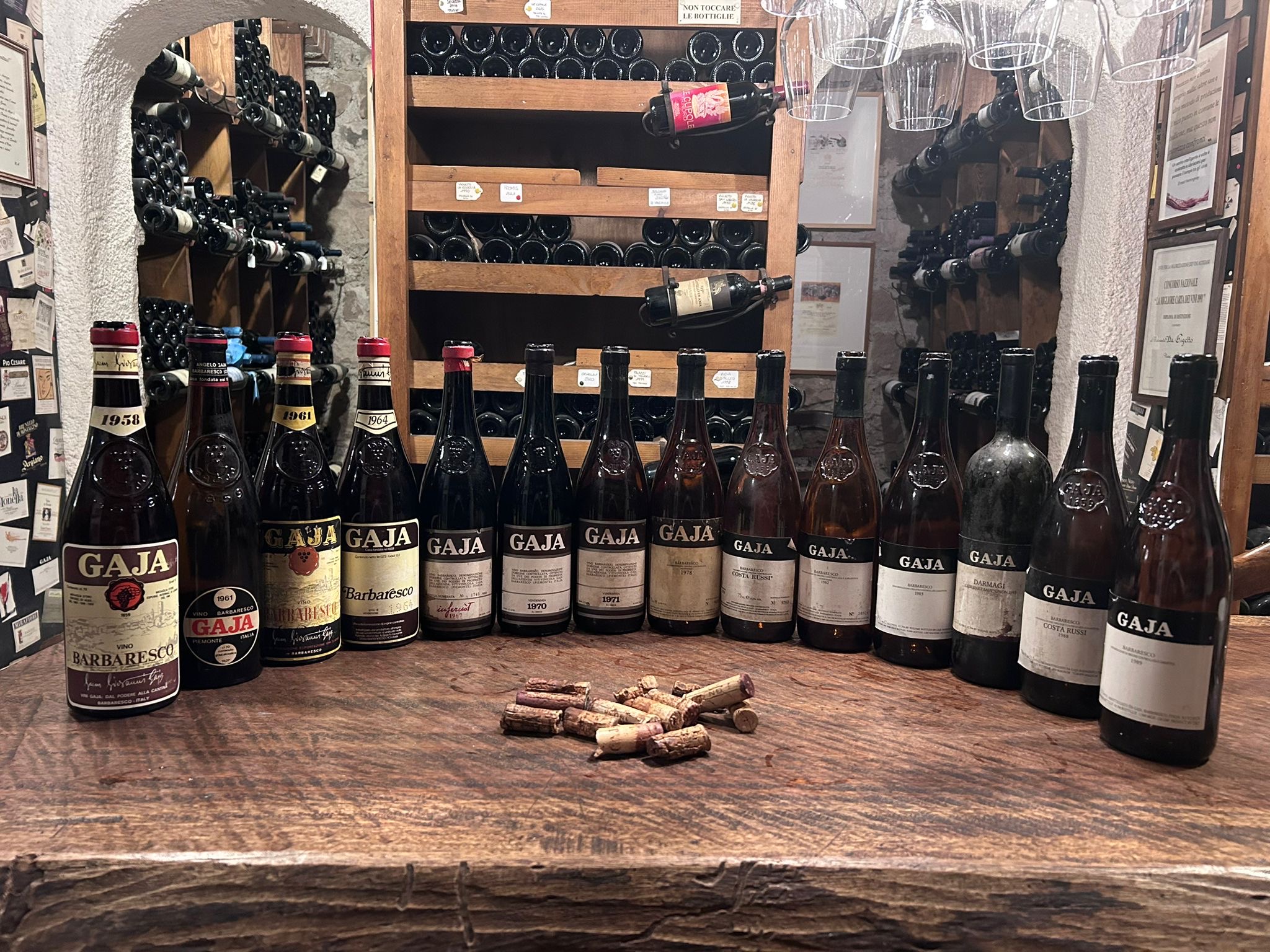
It was a deeply moving experience to retrace some of the key milestones in the estate’s evolution through the tasting of 14 bottles that shaped the winemaking history of Barbaresco, the Langhe, and Italy.
This journey was passionately conceived and curated by wine enthusiast Renato Sperandio, who, in addition to drawing from the cellar of the restaurant Da Gigetto, also received the collaboration of Angelo Gaja himself to create an exceptional lineup.
We began with a 1958 Barbaresco signed by Giovanni Gaja, Angelo’s father, featuring a colorful label that reflected a desire to look beyond the difficult post-war years. The 1961 vintage was presented in two versions: a deep, warm, and savory Barbaresco, and an exclusive edition deliberately created by Angelo Gaja, who from that harvest onward began signing the family’s productions. The 1964 vintage proudly displays the newly established Barbaresco DOC designation on its label.
A rare Infernot, produced from carefully selected Nebbiolo grapes suitable for long aging in large casks, appeared with the 1967 vintage: a limited release of just 5,000 bottles, making it a mythical wine among enthusiasts.
The evolution of the label design progressed alongside the now well-established management of the founder’s son. The fresh and lively 1970 stands beside the more introspective and linear 1971. The trio that followed was recognized blind by the fortunate participants as true ambassadors of the aromatic and flavor profile of the Langhe: the 1978, warm and generous; the 1979 Costa Russi cru, elegant with a dense tannic structure; and the 1982, commanding on the palate.
Even the colors of the wine evolved over time. From the garnet tones with remarkable transparency seen in the earlier vintages, we begin to perceive a progressively deeper and more impenetrable character in the later years. Alongside intensely ruby hues, the body of the wine becomes enveloped by more pronounced alcoholic sensations. The 1985, 1988 Costa Russi, and 1989 reflect times very different from the early days of the winery.
This journey concludes with a wine from the 1985 vintage that carries the scent of both controversy and revolution. In 1978, Angelo Gaja planted the international variety Cabernet Sauvignon in Barbaresco, and his father’s dismayed frustration ultimately gave the wine its name: Darmagi.
Article by Michele Recchia
Sommelier FISAR and AIS